
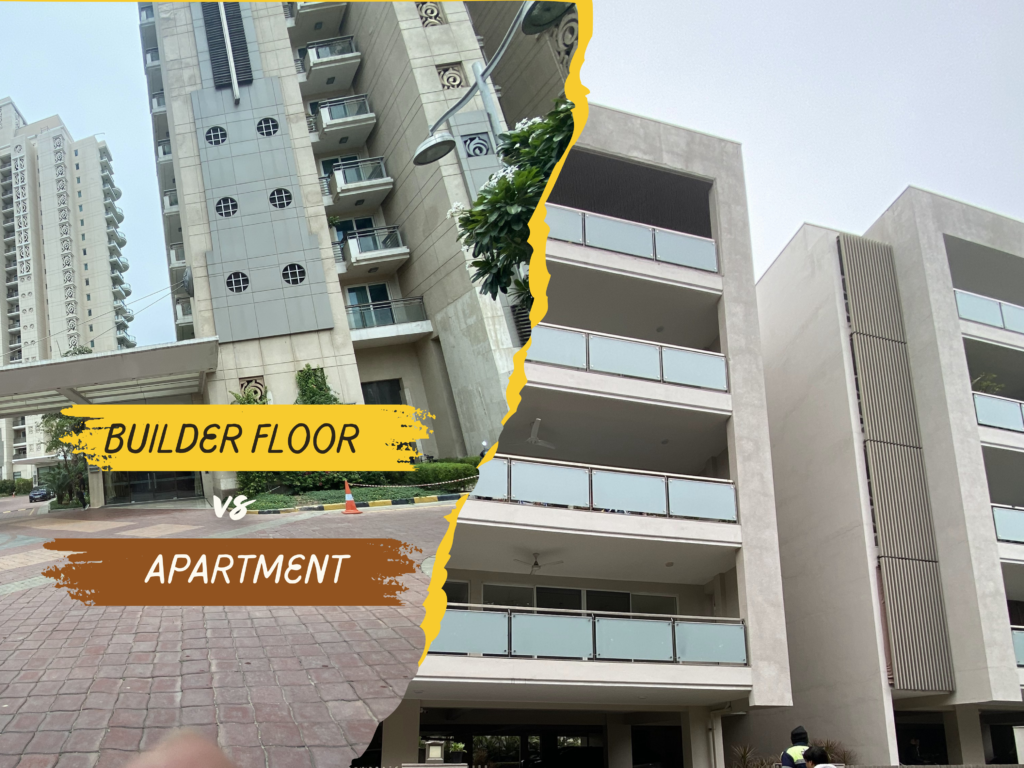
For a home buyer in Gurgaon, the choice between a builder floor and an apartment is not simply a question of which property looks better or offers more amenities.
Both options can work very well, but they are designed around different ownership structures, lifestyles and priorities.
A builder floor may appeal to a family looking for greater independence, privacy, larger floor plans and a more residential neighbourhood. An apartment may be more suitable for a buyer who values professionally managed common amenities, structured maintenance, security systems and community living.
The right decision therefore depends on what matters most to you.
This guide compares a builder floor vs apartment in Gurgaon across ownership, privacy, space, parking, maintenance, amenities, security, location, pricing, resale and long-term usability.
The objective is not to say that one property type is universally better than the other. It is to help buyers understand the differences and decide which option fits their requirements.
If you are already considering a builder floor, our complete guide to buying a builder floor in Gurgaon provides a broader checklist of factors to evaluate before purchasing.
What Is a Builder Floor?
A builder floor is an independent residential floor within a low-rise or relatively low-density residential building.
Depending on the property and applicable legal and development framework, different floors may be separately owned or transferred, while certain parts of the building and underlying property may be shared or subject to common rights.
Builder floors in Gurgaon can vary considerably.
A property may be located on a relatively small plot or a large plot, have two or more residential floors, offer dedicated parking, include a lift, and have different arrangements regarding terraces, basements and common areas.
Therefore, the term “builder floor” does not describe one uniform property type.
The buyer should always establish exactly what is being purchased, what rights accompany the floor and what areas are common or exclusive.
What Is an Apartment?
An apartment is generally a residential unit within a larger multi-unit development, usually managed through a defined framework for common areas, facilities and maintenance.
Depending on the development, an apartment community may offer facilities such as:
- Clubhouse
- Swimming pool
- Gymnasium
- Children’s play areas
- Landscaped gardens
- Security systems
- Visitor management
- Internal roads
- Community spaces
- Sports facilities
The extent of amenities varies significantly from one development to another.
An apartment buyer should therefore evaluate the actual project rather than assuming that every apartment development provides the same facilities or level of management.
Builder Floor vs Apartment in Gurgaon: Key Differences
The easiest way to understand the choice is to compare the two property types across the factors that matter most to a home buyer.
| Factor | Builder Floor | Apartment |
|---|---|---|
| Building scale | Usually low-rise and lower-density | Usually larger multi-unit development |
| Privacy | Generally higher due to fewer residential units | Depends on project density and layout |
| Common amenities | Usually limited | Often extensive |
| Maintenance | Owners may coordinate many common requirements | Usually professionally or centrally managed |
| Community environment | Smaller and more private | Larger community |
| Floor independence | Generally stronger | Unit is part of a larger development |
| Parking | Property-specific | Usually allocated according to project arrangements |
| Security | Property/community specific | Often centralised |
| Open spaces | Depends on plot and property | Often planned within the development |
| Maintenance charges | Often lower, but varies | Can be significant depending on facilities |
| Location | Often established residential neighbourhoods | Can be established or new growth areas |
| Customisation | May offer greater flexibility, subject to applicable rules | Subject to project and association rules |
| Amenities | Usually fewer | Often more |
| Ownership structure | Requires careful examination of floor and associated rights | Governed by project documentation and applicable law |
| Resale | Depends heavily on location, property quality and buyer demand | Depends on project, location, age and market demand |
This table provides a starting point. The actual experience can vary significantly between individual properties.
Privacy: Builder Floor vs Apartment
Privacy is one of the strongest reasons some Gurgaon buyers prefer independent builder floors.
A low-rise property may have fewer residential units and fewer shared spaces than a large apartment development.
For families who prefer a quieter residential environment, fewer neighbours and less dependence on large common facilities, this can be an important advantage.
An apartment, however, may offer a different kind of convenience. A well-managed development can provide controlled access, security systems and organised common areas while creating a larger community environment.
The question is therefore not simply which offers more privacy.
Ask yourself:
- How many households do I want around me?
- Do I prefer a quieter, low-density environment?
- Do I enjoy community living?
- How important are shared recreational spaces?
- Would I prefer fewer common interactions?
Your answers may point towards one property type more clearly than the headline features of either option.
Space and Layout
Builder floors can be attractive to buyers who want larger residential layouts, independent entrances or fewer restrictions associated with living in a large apartment development.
In established Gurgaon locations, buyers may find builder floors on plots of different sizes, with configurations ranging from compact family homes to large luxury residences.
Apartments can also provide excellent layouts, but the available space is usually designed within the broader planning parameters of the development.
More importantly, buyers should not compare properties simply on the basis of the advertised square footage.
Ask:
- Is the quoted area carpet area, built-up area or another measurement?
- How efficiently is the space planned?
- How much usable living space is actually available?
- Are balconies, utility areas and storage spaces practical?
- Does the layout suit your family?
A smaller but efficiently planned home can sometimes be more functional than a larger property with inefficient spaces.
Amenities: Where Apartments Often Have an Advantage
If lifestyle amenities are a major priority, apartments may have an obvious advantage.
A large residential development may provide access to facilities such as:
- Clubhouse
- Swimming pool
- Gym
- Sports facilities
- Children’s areas
- Landscaped parks
- Community halls
- Security infrastructure
A typical independent builder floor usually does not provide this scale of shared amenities.
Instead, the buyer may get greater independence and a more private residential environment.
Therefore, this is an important lifestyle trade-off.
If your family regularly uses a clubhouse, swimming pool, gym or sports facilities, an apartment may offer considerable value.
If these facilities are not important to you, you may prefer to spend your budget on location, plot size, floor area, interiors or other features of an independent home.
Maintenance and Management
Maintenance is another important difference.
In a large apartment development, maintenance of common infrastructure is generally organised through the project’s management structure, association or facility management arrangements.
This can make day-to-day management convenient, but it also comes with recurring charges.
Depending on the project, these may include expenses relating to:
- Security
- Common-area electricity
- Landscaping
- Lifts
- Clubhouse facilities
- Swimming pool
- Internal roads
- Common repairs
- Facility management
A builder floor generally has fewer shared facilities, so recurring common-area costs may be lower.
However, this does not mean that maintenance is automatically inexpensive.
Owners may need to coordinate expenses relating to:
- Lift maintenance
- Building painting
- External repairs
- Water systems
- Security
- Common electrical systems
- Roof or terrace maintenance
- Other shared infrastructure
The key difference is often centralised management versus greater owner coordination.
Before buying either type of property, understand the actual recurring costs rather than relying on assumptions.
Parking: An Important Gurgaon Consideration
For many Gurgaon families, parking is not a minor detail.
A builder floor may offer dedicated parking arrangements, but the buyer should verify exactly what rights accompany the property.
Do not assume that a physically available parking space automatically means exclusive legal rights to it.
Ask:
- How many cars can be accommodated?
- Is the parking designated or shared?
- What documents establish the parking arrangement?
- Is access convenient?
- Are there restrictions on vehicle size or movement?
- Who maintains the parking area?
Apartments generally have parking arrangements determined by the project’s documentation and applicable rules.
The number of spaces, allocation mechanism, visitor parking and additional parking charges can vary between projects.
In both cases, parking should be verified rather than assumed.
Security: Different Models, Different Priorities
Apartment developments often provide centralised security systems, gated entry, security personnel, CCTV and visitor management.
For buyers who prioritise organised security infrastructure, this can be a significant advantage.
A builder floor in an established residential locality may have a different security model.
The property may be located within a gated pocket, guarded neighbourhood or established residential area, but the exact arrangement varies.
Buyers should evaluate:
- Gated entry
- Security personnel
- CCTV coverage
- Street lighting
- Neighbourhood activity
- Access control
- Emergency response
- Overall surroundings
Do not assume that the word “gated” automatically means the same level of security across every property.
Location Can Matter More Than Property Type
One of the most important mistakes buyers make is comparing a builder floor and apartment only on their physical specifications.
In Gurgaon, location can have a major impact on convenience, lifestyle and long-term marketability.
A buyer may have to choose between:
- An apartment in a newer development farther from established employment hubs, schools and retail areas.
- An independent floor in an established residential neighbourhood closer to the locations the family uses every day.
The reverse can also be true.
A well-located apartment in a strong development may be more suitable than a builder floor in a less convenient location.
When comparing two properties, evaluate:
- Distance to workplace
- Access to major roads
- Metro connectivity
- Schools
- Hospitals
- Retail and daily conveniences
- Restaurants and social infrastructure
- Neighbourhood quality
- Traffic conditions
- Future development
- Resale demand
For a serious buyer, the right location can sometimes matter more than the difference between a builder floor and an apartment.
Builder Floor vs Apartment in Gurgaon: Which Offers Better Value?
There is no universal answer.
Value depends on the price paid relative to the property’s location, size, condition, ownership structure, amenities, maintenance obligations and future demand.
A builder floor may offer value to a buyer who prioritises:
- Larger or more independent living spaces
- Privacy
- Lower-density surroundings
- Established residential neighbourhoods
- Independent access
- Greater control over the home
An apartment may offer value to someone who prioritises:
- Amenities
- Professional management
- Security infrastructure
- Community living
- Recreational facilities
- Predictable common-area management
The right comparison is therefore not:
Builder floor = better
or
Apartment = better
Instead, ask:
Which property gives me the combination of location, usability, ownership structure, amenities and long-term value that best matches my requirements and budget?
What About Resale Value?
Resale should be considered carefully because neither property type guarantees appreciation.
For a builder floor, resale demand can be influenced by:
- Location
- Plot size
- Floor position
- Construction quality
- Age
- Parking
- Layout
- Documentation
- Neighbourhood
- Pricing
- Buyer demand
For an apartment, resale can depend on:
- Project reputation
- Location
- Developer
- Age of the development
- Maintenance quality
- Amenities
- Supply of competing units
- Floor and orientation
- Unit size
- Maintenance charges
- Buyer demand
A premium location with strong underlying demand can matter more than the broad classification of the property.
This is one reason buyers should avoid choosing a property solely because they expect one category to automatically appreciate more than another.
Which Is Better for Families?
The answer depends on the family’s lifestyle.
A builder floor may suit you if:
- You value privacy.
- You prefer a low-density residential environment.
- You want an independent or more private living arrangement.
- You prefer established neighbourhoods.
- You want greater independence from large community facilities.
- You do not consider extensive club amenities essential.
- You are comfortable understanding and managing property-specific maintenance.
An apartment may suit you if:
- You want extensive shared amenities.
- You prefer professionally managed common areas.
- Security infrastructure is a major priority.
- Your children regularly use community facilities.
- You enjoy larger residential communities.
- You prefer centralised maintenance.
- You are comfortable paying recurring maintenance and facility charges.
Neither list is absolute.
A family’s priorities can change over time, so think beyond your immediate requirements.
Builder Floor vs Apartment for Senior Citizens
This comparison deserves special attention for families with elderly parents.
A builder floor can offer advantages such as a quieter environment, fewer neighbours and potentially easier access in a low-rise building.
However, buyers should carefully consider:
- Lift availability
- Staircase design
- Entrance access
- Parking-to-home distance
- Medical facilities nearby
- Emergency access
- Daily shopping
- Security
An apartment may provide better accessibility and centralised security in some developments, but this varies considerably.
The actual building should be inspected rather than making a decision based solely on property category.
What About Investment?
If you are buying primarily as an investment, do not choose between builder floor and apartment based only on past appreciation stories.
Evaluate the individual property and its market.
Consider:
- Entry price
- Rental demand
- Likely tenant profile
- Resale liquidity
- Location
- Future infrastructure
- Competing supply
- Maintenance costs
- Transaction costs
- Property age
- Documentation
- Buyer demand
A property that looks inexpensive may not necessarily be good value if resale demand is weak.
Similarly, a higher-priced property may justify its price if the location, quality and long-term demand support it.
Investment decisions should also be considered in light of your financial position and tax circumstances, for which independent financial or tax advice may be appropriate.
What Should You Check Before Choosing a Builder Floor?
If you decide that a builder floor is more suitable for your family, the next step is proper due diligence.
At minimum, evaluate:
- Location and neighbourhood.
- Plot size.
- Exact floor and configuration.
- Construction quality.
- Parking arrangements.
- Lift and common facilities.
- Ownership and title.
- Applicable approvals.
- Floor-specific rights.
- Pricing compared with comparable properties.
- Outstanding dues or liabilities.
- Resale prospects.
Our builder floor documents guide explains the documents buyers should consider reviewing.
You should also understand how to verify a builder floor before buying in Gurgaon, rather than relying solely on the seller’s representations.
What Should You Check Before Buying an Apartment?
Apartment buyers should also carry out detailed due diligence.
Consider:
- Developer and project background.
- Title and project documentation.
- Applicable approvals.
- Unit specifications.
- Carpet area and other area measurements.
- Parking.
- Maintenance charges.
- Club and amenity charges.
- Possession status, where relevant.
- Construction quality.
- Association or management structure.
- Resale and rental demand.
- Project’s location and surrounding infrastructure.
The fact that an apartment belongs to a large development does not remove the need for property due diligence.
A Simple Decision Framework
If you are still unsure, ask yourself these seven questions:
1. Do I value privacy more than amenities?
If yes, a builder floor may deserve closer consideration.
2. Will my family regularly use clubhouse and recreational facilities?
If yes, an apartment may offer greater lifestyle value.
3. Do I prefer an established low-density neighbourhood?
If yes, explore builder floors in established Gurgaon locations.
4. Do I want centralised maintenance?
If yes, an apartment may be more convenient.
5. Am I comfortable coordinating some property-level maintenance?
If yes, a builder floor may work well.
6. What matters more: the property type or the location?
Always compare the actual locations before making the decision.
7. Have I compared the total cost of ownership?
Look beyond the purchase price and consider maintenance, parking, repairs, amenities, taxes, transaction costs and other recurring expenses.
Builder Floor vs Apartment in Gurgaon: The Bottom Line
There is no universally correct answer to the question of whether a builder floor or apartment is better.
A builder floor may be the better fit for a buyer who values privacy, independence, lower-density living and established residential neighbourhoods.
An apartment may be the better choice for someone who values amenities, community living, centralised maintenance and organised security infrastructure.
The most important point is to compare the actual properties, not just the categories.
A well-located, well-maintained apartment can be a better purchase than a poorly documented builder floor.
Likewise, a properly verified builder floor in a strong residential location may be a better fit for a family than an apartment whose amenities they rarely use.
Before making your decision, compare location, ownership, documentation, construction, usable space, parking, maintenance, amenities, total cost and long-term marketability.
If you are considering a builder floor in Gurgaon, you can explore our available luxury builder floors for sale or browse our Gurgaon residential locations.
At Luxury Floor in Gurgaon by Diwan Realty, our approach is to help buyers understand their options and evaluate properties based on their individual requirements rather than assuming that one property type is right for everyone.
The best home is not necessarily the one with the most features. It is the one that fits your lifestyle, location requirements, budget and long-term plans.
Frequently Asked Questions
Is a builder floor better than an apartment in Gurgaon?
Neither is universally better. Builder floors can offer greater privacy, independence and low-density living, while apartments may provide more amenities, centralised maintenance and organised security. The right choice depends on your lifestyle, budget, location preference and long-term requirements.
What is the main difference between a builder floor and an apartment?
A builder floor is generally a floor within a low-rise residential building with greater floor-level independence, while an apartment is typically a unit within a larger multi-unit development. Ownership rights, common areas and maintenance arrangements can vary significantly between properties.
Are builder floors more expensive than apartments in Gurgaon?
Not necessarily. Pricing depends on location, plot size, floor area, construction quality, age, amenities, project characteristics and market demand. A meaningful comparison should consider the actual properties rather than only the property category.
Which is better for privacy: a builder floor or apartment?
A builder floor may offer greater privacy because it is generally part of a smaller, lower-density building. However, privacy depends on the specific building, number of occupants, layout and surrounding environment.
Do builder floors have better resale value than apartments?
There is no universal rule. Resale depends on location, property quality, documentation, pricing, demand, age, maintenance and competing supply. Both builder floors and apartments can perform differently depending on the specific market and property.
Are maintenance costs lower for builder floors?
They can be, particularly where there are fewer shared amenities and facilities. However, owners may have to coordinate repairs and maintenance themselves. The actual cost depends on the building and the facilities provided.
What should I verify before buying a builder floor?
Buyers should evaluate ownership, relevant property documents, applicable approvals, construction, floor-specific rights, parking, outstanding dues, pricing and the proposed transaction documents. Independent legal and technical advice should be obtained where appropriate.
Disclaimer: This article is intended for general educational and informational purposes only. It does not constitute legal, financial, tax, architectural, structural or investment advice. Property characteristics, ownership arrangements, approvals, costs and applicable requirements vary by individual property and location. Buyers should conduct appropriate due diligence and obtain independent professional advice before making a purchase.